
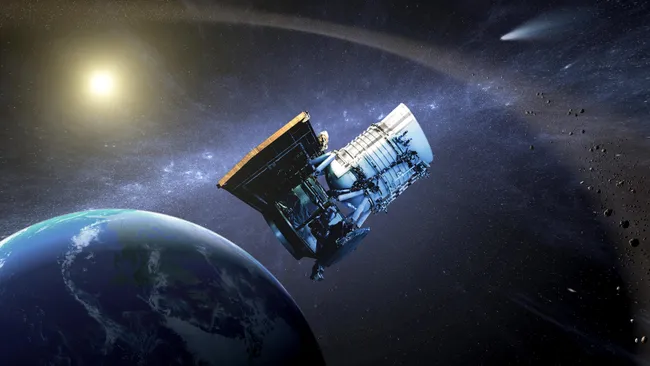
After more than a decade and a half of service, NASA’s NEOWISE spacecraft, a crucial part of its planetary defense program, has officially ended its mission. The asteroid-hunting telescope, which had been operating on borrowed time, was decommissioned on August 8. It will now continue a slow descent toward Earth, where it is expected to safely burn up in the atmosphere later this year.
The mission’s end comes as the spacecraft, lacking the fuel to boost its orbit, has been gradually pulled closer to Earth’s atmosphere by a period of peak solar activity. The sun’s increased heat has caused our atmosphere to expand, creating drag on the satellite and accelerating its fall.
The NEOWISE mission had a long and unexpected career. It was launched in 2009 as the Wide-field Infrared Survey Explorer, or WISE, with a primary mission of just seven months to map the entire sky in infrared light. It was initially designed to look for faint light from the early universe, but scientists soon discovered it was far more sensitive than anticipated.
Following this discovery, NASA extended the mission and repurposed the telescope. In 2011, it was renamed NEOWISE and tasked with surveying the main asteroid belt between Mars and Jupiter. It was put into hibernation in 2011 when its coolant ran out, making its infrared sensors less sensitive.
However, the mission was not over. In 2013, NASA brought the spacecraft out of hibernation after realizing it could still detect near-Earth objects by observing the sunlight they reflected. For over a decade, NEOWISE has served as a valuable planetary defender. During its extended career, NEOWISE detected over 200 new near-Earth objects, including 25 new comets, and cataloged 44,000 other objects that passed through our solar system.
Its legacy will continue with NASA’s next-generation mission, the NEO Surveyor, which is already under development and scheduled to launch no earlier than September 2027. This new infrared space telescope will be even more advanced, with an innovative solar shade that will allow it to spot asteroids near the sun’s glare, a known blind spot for planetary defense.
Until the NEO Surveyor is in orbit, ground-based telescopes like the Catalina Sky Survey in Arizona and Pan-STARRS in Hawaii will carry on the crucial work of tracking and detecting near-Earth objects to protect our planet.

Leave a Reply